Headless Alcohol Ecommerce: Connecting Checkout | Bottle Nexus
A practical guide for alcohol brand ecommerce leaders evaluating how a custom interface should connect checkout, retailer fulfillment, and customer communications.

Headless alcohol ecommerce needs a dependable connection between the experience a brand designs and the transaction its commerce infrastructure can support. Before choosing an interface, define how it will establish purchase availability, submit checkout information, communicate order status and identify the licensed seller.
Bottle Nexus provides headless/API commerce technology for custom interfaces. In our retailer-connected model, participating licensed retailers are the merchants of record and fulfill alcohol orders; availability varies by product, retailer and delivery address. Those roles should shape the interface from the start.
For an alcohol brand evaluating a custom build, the central decision is how much control the customer experience requires—and what integration work that control creates.
Separate the design decision from the architecture decision
A custom checkout describes an experience: its appearance, language and interaction. Headless architecture describes how the customer-facing interface connects to the commerce system behind it. A distinctive checkout design alone does not establish that an implementation is headless.
Bottle Nexus offers custom checkout and headless/API options. The practical starting point is to identify the customer requirement that makes a separate interface useful. That might be a product discovery journey, a mobile experience, or a purchase flow within an existing application. These are possible project requirements, rather than claims about completed Bottle Nexus implementations.
Write the requirement in customer terms: “A shopper should be able to select a bottle, establish whether it is available for their destination, and understand the next step without losing their selection.” That gives the integration team something concrete to evaluate.
Define the connection before approving the screens
A useful planning tool is a connection contract: a shared description of what the interface sends, what the commerce system returns, and what the customer sees when a step cannot proceed.
The following is a proposed requirements model, not a description of every available Bottle Nexus endpoint:
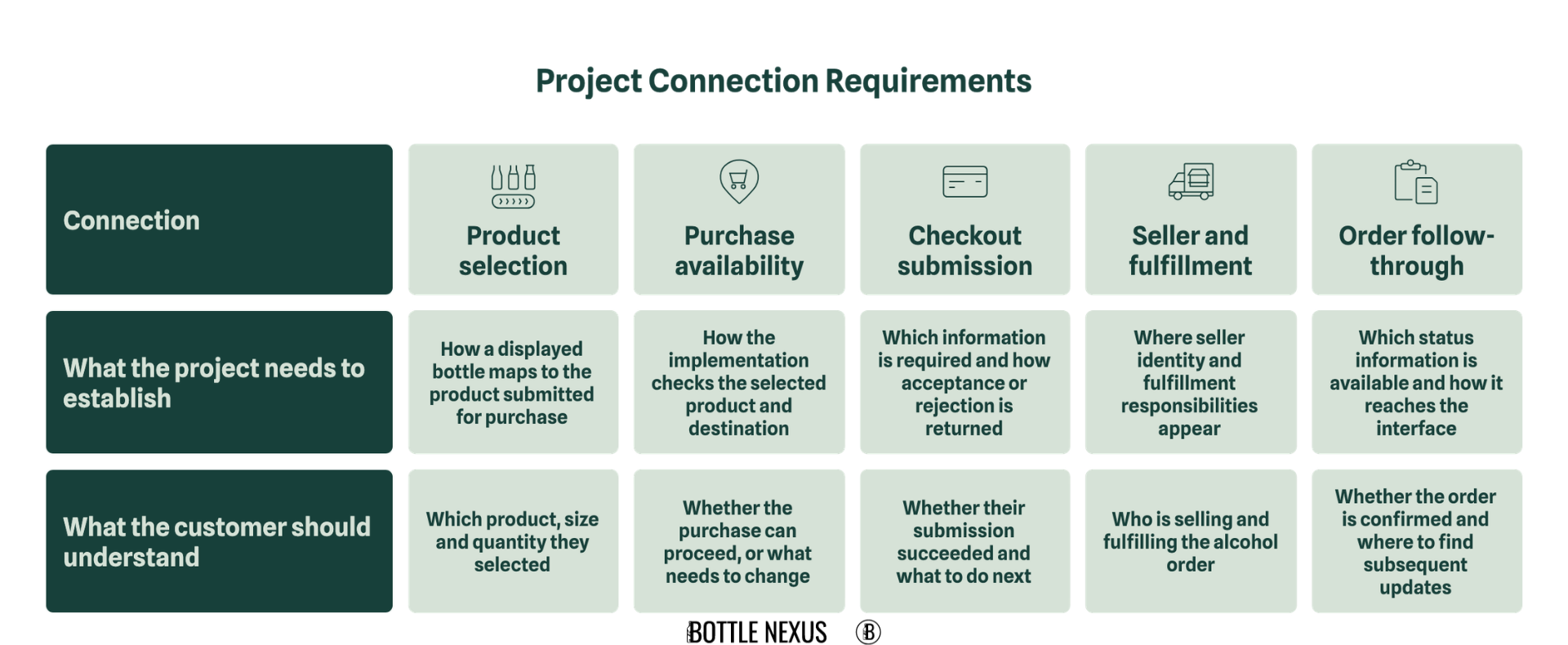
Resolve these connections before polishing the final purchase screen. Each one affects the language, states and recovery paths the design must accommodate.
Make availability part of the buying journey
A product page and a purchasable order answer different questions. The first explains the bottle; the second establishes whether the selected purchase can proceed.
For Bottle Nexus-connected purchases, coverage depends on the product, participating retailer, and delivery address. The design implication is straightforward: decide when destination information is needed and how the interface will respond if the selection is unavailable.
Consider an illustrative limited-release journey. A shopper selects two bottles, enters a delivery address, and encounters an availability restriction. The integration brief should specify whether the interface preserves the selection, explains the restriction, and offers a supported next step. It should also establish whether changing the address or quantity requires another check.
This example is a design test, not a reported customer result. Its value is that it exposes missing decisions before they become confusing checkout behavior.
Keep the seller visible within the brand experience
A brand can own the presentation of a purchase journey while a licensed retailer performs the seller and fulfillment roles. Bottle Nexus supplies the connecting commerce technology; participating retailers remain the merchants of record.
The interface should make those responsibilities understandable through seller information, fulfillment explanations, and support directions at the relevant points in the journey.
This separation also matters when reviewing compliance requirements. TTB explains that state governments usually regulate businesses selling or serving beverage alcohol to consumers. A headless architecture does not itself establish permission for a particular transaction. The implementation review needs to address the applicable seller, product, and destination requirements with qualified advisers.
Design for uncertainty as carefully as success
A submission can leave the customer waiting without a clear answer. A useful alcohol checkout integration brief should therefore address more than the successful path.
Establish what happens when a customer clicks twice, a request times out or an address changes after an earlier check. Confirm the supported method for determining whether an order exists before allowing another submission. Define which errors the customer can correct and which require support.
These are requirements to resolve against the agreed technical specification, not assumed API capabilities. They help prevent the interface from displaying a confident confirmation before the underlying transaction supports it.
Keep the customer’s work wherever possible. An actionable message beside the relevant field is more useful than a generic failure screen that forces the shopper to start again.
Judge the interface by completion and clarity
Headless architecture creates design choices; the quality of those choices still needs testing. Baymard’s checkout research reports that 17% of surveyed shoppers had abandoned an online purchase during the preceding three months because checkout was too long or complex. That finding concerns ecommerce generally, rather than alcohol specifically or Bottle Nexus performance.
For a proposed build, test whether shoppers understand availability, required information, seller identity, and confirmation. Include unavailable products, unsupported destinations, and interrupted submissions alongside the successful purchase path.
Start with a transaction walkthrough
Bring Bottle Nexus one representative customer journey, the systems it needs to connect, and the information your team expects at each step. Our headless/API offering provides the starting point for that integration discussion.
Before commissioning the full interface, work through product selection, destination checks, submission, and order follow-through with the Bottle Nexus team. Confirm the supported operations, data fields, payment approach, and responsibility for each customer message. That walkthrough turns an alcohol ecommerce API discussion into a concrete build decision: what the customer needs, what the integration supports, and what your team will maintain.
Let’s make
great connections.
You bring the spirit. We bring the technology to connect your brand with what comes next.
Meet Bottle Nexus